Thursday, 9 April 2020

Gethsemane


And did your mother stay awake?
While others slept
did she, unasked, lie wakeful
as mothers often do?
Did she remember
acclamation of elders
adoring her child,
the recognised awaited one?
And did the long-dreaded sword pierce sharp that night,
preventing slumber
disturbing rest?
Did she watch unseen, unseeing
as you sweated blood?
And did she pray that angels would once more attend?
                               
(©Ruth M Gee 2015)

Wednesday, 8 April 2020

Fragrance of perfume


Fragrance of perfume

Jesus came to Bethany and there they gave a dinner for him. The friends gathered, the talked and ate together. Martha served and her brother Lazarus was at the table with them. How thankful they must have been that Lazarus was there, alive and released from the tomb by Jesus.

Things were normal again, Lazarus was well and the friends could gather each taking their familiar place. 

And then Mary changed things. Mary who had sat at Jesus’ feet and listened to him, Mary who had wept at Jesus’ feet outside her brother’s tomb. Mary broke all conventions now in one costly extravagant action as she took costly perfume and poured it over Jesus’ feet before wiping them with her hair. An extravagant, intimate and fragrant action. “The house was filled with the fragrance of the perfume”

Some protested at the extravagance. Some thought the perfume could have been better used, could have benefitted more deserving people, could be sold to raise money for the poor.

Jesus, friend of the poor, friend of all, received the gift and through it pointed to his own mortality. The blessing of his physical presence was to be treasured and celebrated, it was to end all too soon. The fragrance of the perfume filled the house but would disperse and be held as a profound memory, recalling presence, laughter, friendship and extravagant life-giving love.

When such physical companionship was no longer possible the love would remain. And after death would come new life, new hope and new joy. But for now this was only a promise, a promise barely heard and not yet understood; a promise of restoration, life and joy.


Fragrance of perfume,
            given in love;
Fragrance of perfume,
            anointing the flesh;
Fragrance of perfume,
            blessing of God.
Fragrance of perfume,
            filling the house;
Fragrance of perfume,
            filling my life;
Fragrance of perfume,
            aroma of grace.

(based on John 12:3)

©Ruth M Gee  


Monday, 6 April 2020

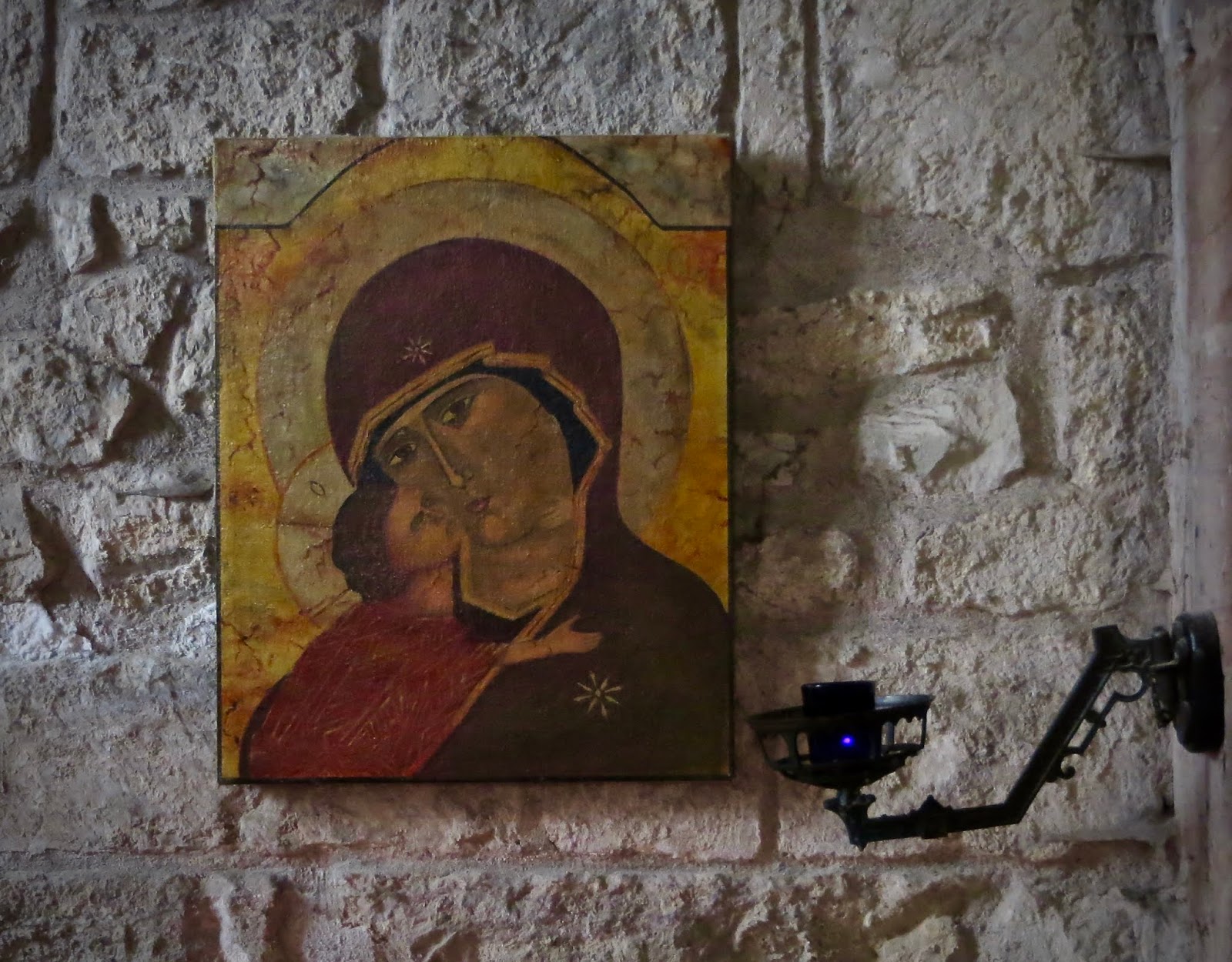
Did you remember? - a reflection for Holy Week

How they looked at me, my children.
Shared moments of love and trust,
eyes meeting, bonds forming,
bonds that held strong
binding me to them for ever,
binding my eyes, my heart, my tears, my smiles.
I feel their arms around my neck,
smell the baby skin,
small fingers pulling gently at my hair.
I remember.

Did you remember precious moments too,
returning to you, sharp and sweet
as you watched him ride into Jerusalem?
Did you feel his arms around your neck
and long to hold him safe?
Did your eyes meet his
binding you in sorrow, fear and aching love,
Bitter sweet,
stirring longing
to ease his journey,
to make all well?

Written in St Mary's Church, Lindisfarne on Palm Sunday 2015, following morning worship and inspired by the icon of the Madonna and Child in that place (pictured above).


Ruth M Gee

Sunday, 5 April 2020

It made me wonder

It wasn’t the colt that made me wonder, not even the way they came into the village and just took it for him to ride. I was surprised how easily Jacob let it go but he had met the preacher before and perhaps they had an arrangement. It was a beautiful young animal but there are plenty of them around. It wasn’t the colt. 
And it wasn’t the singing and the shouting of Hosanna! That was exciting and stimulating, it always is when the pilgrims arrive, so full of hope and enthusiasm. We all want freedom from occupation, freedom from fear and uncertainty, freedom to be fully the people the Lord has created us to be – we all sing and shout.
It wasn’t the size of the crowd that made me wonder, or the heavy military presence or the anger of the religious leaders at all the enthusiasm.
What made me wonder were the green leaves waved and laid down as a thick living carpet marking the way to the temple. Pilgrims often wave the branches of palm and olive as they sing, but to lay them down like that and so many of them; to place the symbols of spring and of new life and hope under his feet - that made me wonder. Was this a celebration of life or was the trampling of the leaves a sign of death? Was his journey through the crushed and trampled leaves the way that new life and hope would come as we shouted Hosanna? Was our God going to save us through death and bring us new life?
How could that be true? 
I wonder...
Lord, as we lay down our palms and follow you into Jerusalem, bring us with you through death to life we pray.


(Ruth M Gee 2015)

Sunday, 1 April 2018

The Gardener


I love the feel of the earth in my hands, the warm crumbly texture of it as it sifts through my fingers. It is full of life, teeming with the promise of new growth, dancing with the joy of creation. In the soil is the hope, the past and the future of life. In its primeval promise it embraces the love of the creator.

I worked at the first in the creator’s garden, a fertile area where we could always hear the bubbling, laughing voice of the four rivers carrying the living water to the soil. It was joyful work; innovative and exciting. We watched the first flowers grow and named them according to their colour or their scent. The trees were tall and strong, their roots reaching down into the heart of things and drawing sustenance from the source. The fruit on those trees was voluptuous in shape and taste, juices ran down your face as you ate, anointing and nourishing.

My favourite flowers, and his, were the poppies. Their prodigality never ceased to amaze me; carpets of fragile red blooms, extravagant in colour, delicate to touch and fleeting in bloom. They were so beautiful, regally clothed, exulting in the joy of life.

We had to leave, of course. I suppose it was inevitable that we would be unable to resist that fruit, the forbidden fruit. We had so much that we could eat, an abundance of beauty and taste but we had to have it all. ‘All or nothing’ we said and, as it turned out they were the same thing. We didn’t look back as we left but the brightness of the garden shone from behind us and sometimes, when I look towards the sun, I think I see the place again.

There were many gardens after that and my joy in the soil never left me but it was harder now to release its promise. The flowers still grew and with them the persistent weeds. Weeds that threatened to strangle the delicate shoots, to suck the goodness from the soil, to prevent new life and darken hope.
Weeds that would pull the flowers up if you attacked them too soon, weeds of synthetic beauty, sculpted to deceive, subtle in subversion.

The poppies still bloomed, nothing could stop them, so persistent and generous in their flowering are those lilies of the field. They always remind me of his love and care, his delight in his creation. But I was surprised to see them that morning.

It had been a dark week-end, not good for growing. I went to the garden expecting the earth to be weeping, weeping like women, in need of anointing. It began softly at first, a familiar grief, well known and appropriate. Then the shock of emptiness led to despair, to absence and uncertainty, to loneliness.

..............

The weeping drew me across the waking earth. The grass was wet with dew, springing up at every step, quenching thirst, inviting new life. Gossamer threads, spider sculpted, reflected the promise of morning light. Still she wept. I spoke her name, She turned, hope dawning in her eyes. Around our feet the poppies danced in jubilation and, bathed in brightness, we celebrated our homecoming.


For since by man came death, by Man also came the resurrection of the dead. For as in Adam all die, even so in Christ all shall be made alive.’ (1 Corinthians 15:21-22)

©Ruth M Gee 2011

Saturday, 31 March 2018

Harrowing of Hell

Crucified Christ today I pray:

For those imprisoned by pain,
where physical torment prevents fullness of life
and for the watching ones enduring agony
held in helplessness when they would offer all;
Harrow their hell.

For those who are not heard,
whose voices are silenced by the powerful,
whose whispers fall on deaf ears;
Harrow their hell.

For those whose horizon is diminished,
those held in despair
in the pit of depression,
hearing too many voices claim their allegiance;
Harrow their hell.

For those who sleep in the day
because the night is too dangerous,
seeking shelter in closed doorways;
Harrow their hell.

For those whose love is deemed unworthy
by those who cannot love beyond themselves,
excluded and derided,
unheard, unseen unnamed;
Harrow their hell.

For those who are ever hungry,
denied food, education, health and dignity,
praised for their resilience
not naming the inequality;
Harrow their hell.

Watching and waiting,
Lord we pray
Harrow the hells of your people today.

Saturday, 6 January 2018

Mystery of Epiphany

Today is the feast of the Epiphany, a day when we remember especially the visit of the magi, wise men or kings to the baby Jesus. We know the carols about the kings of orient who bear their gifts of gold, frankincense and myrrh. We have given them names: Caspar, Melchior and Balthasar. Children have put on crowns and carried gifts in nativity plays. We see them riding or leading their camels on our Christmas cards. We allow them to arrive early and mingle with shepherds from another story.

The visitors from lands afar, those who followed the star, remind us of the obligation to welcome the stranger as one from whom we can learn and receive. They remind us not to underestimate the significance of the strangers who knock on our door but to welcome them in for we may be entertaining angels unaware.

The gifts that the strangers bring are gloriously inappropriate, extravagant and unexpected. The message carried in the gifts is no less a surprise - that this baby will be honoured as king and God and that his death is foreshadowed even in his birth.

The magi came, they brought their gifts, they followed their star and then returned another way avoiding Herod and perhaps delaying his response to the birth of a son to Mary and Joseph, ordinary folk blessed by God in God's complicated way.

The magi left, the family fled - I wonder what happened to the gold and the frankincense?

The myrrh could have been used many times over in the aftermath of that visit. As Herod's troops massacred the children, breaking their fragile, precious bodies, finding in their innocence a threat to grasped, snatched power. There were many small bodies to be anointed, many fathers and mothers left in despair, many children left alone as their young siblings died. The myrrh was useful all too soon, the gold and frankincense would have to wait their turn.

Epiphany, like Christmas, is a time when we can meet with God in our encounter with the baby whose birth brought joy, angel songs and extravagant gifts along with homelessness, flight and the slaughter of children.

In all these things God is with us.
This is a great mystery.