I don't know what made me do it.
I was on the train when she walked quietly past me and put a pack of tissues on the table. A pack of tissues with a note. The note said she was a single mother without work who was struggling to pay the rent and buy food for her small daughter. A plain statement of facts. Facts followed by the request to buy the pack of tissues.
Of course, they might not have been facts. I had no evidence, no proof of her circumstances.
She was just a quiet, nonthreatening presence on the train.
Handing out packs of tissues for sale.
Price left to my discretion.
A few minutes later she passed by again. Still no words just a questioning glance as she picked up the note.
I handed over the money and she gave me the tissues, speaking the only words in the transaction, "thank you".
I have wondered since then.
Why did I buy those tissues?
I had my usual stock of balsam tissues in my bag.
I did not know her.
I could not tell if her story was true.
So why, on this occasion, did I hand over the money.
Was it her quietness and gentle approach?
Was it because of the child (real or imaginary)?
Was it because the product was useful?
Was it because she was a woman?
I don't know.
All I know was in that moment, I felt it was the right response, the only response to make.
A drop in the ocean of human need.
No great altruistic act.
The simple purchase of a pack of tissues.
But she stays in my thoughts and I pray for her and for her child.
Saturday, 18 October 2014
Wednesday, 10 September 2014
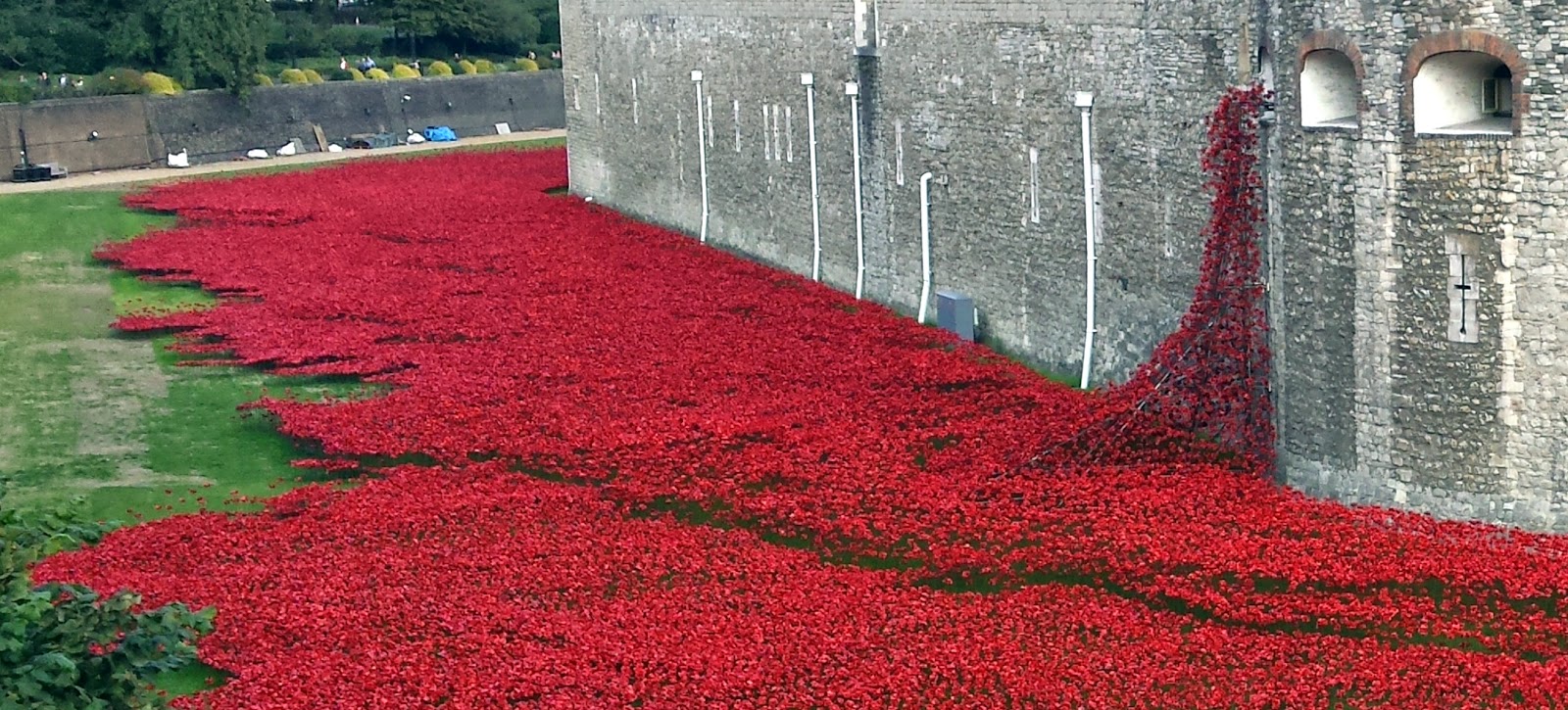
Poppies?
Poppies?
You are not transient.
You do not droop and fall.
Immutable
You stand tall and proud.
Sanguine
blood red,
redolent of beauty
bleeding from the tower -
yet your pooling does not soak into the earth.
For you there is no muddy bed.
No death for you,
No sharing in their lot.
They are gone.
They have fallen.
Their blood has fed the earth.
Dust to dust
mutable
contingent
mortal
They have perished.
A travesty perhaps.
But rather,
in your unchanging
blood-red
sanguine
beauty -
You are the memory.
We will remember them.
Poppies.
Sunday, 17 August 2014
WWJD - What would Jesus Do?
I have never owned or worn a wrist-band or any other item carrying the letters WWJD. This is for two main reasons: firstly I don't wear logos from personal preference (apart from my cross), secondly I think the answer to WWJD? would most often be "I don't know for sure". It simply doesn't work to think that we can know what Jesus would do in every or any situation; even his closest friends often got it wrong when they tried to second guess him. Add to that all the complexities of textual analysis, historical literary criticism and reader response and WWJD doesn't work for me as a simple means of working out detailed response to specific situations.
Having said all that there have certainly been times when I have tried to work from the basis of WWJD when working out my own response. Let me give an example.
A few years ago a family friend asked me if I would be willing to conduct the funeral service for her husband. She said that they understood that I might not feel able to do so because he was a convinced atheist and though he would like me to preside I would not be able to talk about God or Jesus. As I made my decision I was conscious that I was asking myself what I thought Jesus would do. My conclusion was that Jesus would want to take the opportunity of being alongside people at a time of great sadness and would want to meet them where they were and minister to them there. I took the service. I didn't wear any clerical clothing but I did wear my cross, explaining that I was never without it and it expressed something about who I am. The family agreed that this was completely appropriate and when they produced the printed order of service I was named as Rev. Ruth Gee. I maintained my personal integrity, I spoke about the hope of resurrection but in words that were accessible and not overtly "religious" or Christian. After the service those who were atheist commented that it had been very helpful and "not religious." Those who were Christian said they had clearly heard the Christian message of hope and love. I hope this meant that I had preached the gospel in an accessible way. Of course, it might just mean that I was sitting on the fence. I am still sure that offering to be with people and to meet their needs as far as I could was following the example of Jesus but I know and accept that others would say that following Jesus would lead to a different course of action.
Over recent weeks my facebook and twitter streams have been full of discussion about very significant world events - Gaza, Israel, Iraq, Syria, Ukraine. There has also been much discussion around human sexuality, the death of well-known people, the marking of the outbreak of war, political and social issues. Quite properly Christians have responded from the basis of their understanding of what our faith requires of us. It is not surprising that there are different conclusions drawn. It is not surprising that there are not always easy answers.
What would Jesus do?
I don't know, not in detail. I do know that he would value and love each person. I do know that he would seek peace and justice. I am also uncomfortably, fairly certain that he would challenge me and my pre-suppositions.
I am uneasy how often those who are in debate seem to know exactly what Jesus would do. How often the absolute answers are given. How quickly responses are made to media reports, assuming that the whole story is known. How often the absolute necessity to stand alongside people who are being victimised and abused closes our eyes to others who need us to stand alongside them and listen to them as they are victimised and abused too.
What would Jesus do? It is important for his followers to ask the question.
I think it is also important to realise that we don't always have an easy answer.
Jesus still surprises and challenges his disciples.
Having said all that there have certainly been times when I have tried to work from the basis of WWJD when working out my own response. Let me give an example.
A few years ago a family friend asked me if I would be willing to conduct the funeral service for her husband. She said that they understood that I might not feel able to do so because he was a convinced atheist and though he would like me to preside I would not be able to talk about God or Jesus. As I made my decision I was conscious that I was asking myself what I thought Jesus would do. My conclusion was that Jesus would want to take the opportunity of being alongside people at a time of great sadness and would want to meet them where they were and minister to them there. I took the service. I didn't wear any clerical clothing but I did wear my cross, explaining that I was never without it and it expressed something about who I am. The family agreed that this was completely appropriate and when they produced the printed order of service I was named as Rev. Ruth Gee. I maintained my personal integrity, I spoke about the hope of resurrection but in words that were accessible and not overtly "religious" or Christian. After the service those who were atheist commented that it had been very helpful and "not religious." Those who were Christian said they had clearly heard the Christian message of hope and love. I hope this meant that I had preached the gospel in an accessible way. Of course, it might just mean that I was sitting on the fence. I am still sure that offering to be with people and to meet their needs as far as I could was following the example of Jesus but I know and accept that others would say that following Jesus would lead to a different course of action.
Over recent weeks my facebook and twitter streams have been full of discussion about very significant world events - Gaza, Israel, Iraq, Syria, Ukraine. There has also been much discussion around human sexuality, the death of well-known people, the marking of the outbreak of war, political and social issues. Quite properly Christians have responded from the basis of their understanding of what our faith requires of us. It is not surprising that there are different conclusions drawn. It is not surprising that there are not always easy answers.
What would Jesus do?
I don't know, not in detail. I do know that he would value and love each person. I do know that he would seek peace and justice. I am also uncomfortably, fairly certain that he would challenge me and my pre-suppositions.
I am uneasy how often those who are in debate seem to know exactly what Jesus would do. How often the absolute answers are given. How quickly responses are made to media reports, assuming that the whole story is known. How often the absolute necessity to stand alongside people who are being victimised and abused closes our eyes to others who need us to stand alongside them and listen to them as they are victimised and abused too.
What would Jesus do? It is important for his followers to ask the question.
I think it is also important to realise that we don't always have an easy answer.
Jesus still surprises and challenges his disciples.
Saturday, 16 August 2014
Remembering in August
In the week of August 4th people in the UK were remembering the outbreak of World War 1.
In that week I was in Austria and it was very moving to be there while those commemorations were taking place at home.
In this graveyard at the Catholic Church in Gosau I stopped and looked at a memorial. I don't read German but clearly it was for soldiers who had served in the war and are remembered here.
Later in the week, we visited Salzburg and went to the fortress s.een here at the top of the hill
You can go up the hill the easy way, by funicular or the hard way - we chose.....(for the answer see the end of this blog).
The castle was well worth a visit, the views over the city were spectacular on a hot and sunny day.
We went into the exhibiton area and there I found 10 rooms dedicated to the military history of the Salzburg Rainer Regiment, one concentrating on the first world war.
There were the uniforms of the Austria-Hungarian army and pictures of soldiers from Salzburg who had dies in brutal conditions in battles on the Italian front at Monte Cimone. Young men being comforted by colleagues and by a chaplain as they died in war.
And the fighting still continues in so many places around the world.
We will remember them.
And we will work for peace.
In that week I was in Austria and it was very moving to be there while those commemorations were taking place at home.
In this graveyard at the Catholic Church in Gosau I stopped and looked at a memorial. I don't read German but clearly it was for soldiers who had served in the war and are remembered here.
Later in the week, we visited Salzburg and went to the fortress s.een here at the top of the hill
You can go up the hill the easy way, by funicular or the hard way - we chose.....(for the answer see the end of this blog).
The castle was well worth a visit, the views over the city were spectacular on a hot and sunny day.
We went into the exhibiton area and there I found 10 rooms dedicated to the military history of the Salzburg Rainer Regiment, one concentrating on the first world war.
There were the uniforms of the Austria-Hungarian army and pictures of soldiers from Salzburg who had dies in brutal conditions in battles on the Italian front at Monte Cimone. Young men being comforted by colleagues and by a chaplain as they died in war.
And the fighting still continues in so many places around the world.
We will remember them.
And we will work for peace.
| Yes, we took the hard way up - following others up the hill. This is the last section of the climb. |
Sunday, 10 August 2014
Thoughts from a mountain lake
It is such a beautiful place, this mountain lake. The day was hot and sunny and I could see the tops of the mountains. Walking on the shaded path I could see children, women and men swimming, sunbathing and enjoying time together. sailing boats, motor boats and pedaloes floated past. Some of the motor boats were towing passengers on water skis or suspended in the air above. All was idyllic.
I was with my husband and son and we were enjoying a holiday together, walking, visiting new and interesting places and sharing lots of laughter.
I found myself thinking about the water, the beautiful, clear alpine water - and thanking God for it. Water that is abundant and freely available for recreation and for drinking. Water in which children were playing freely and without fear. Water in beautiful and peaceful surroundings.
And then I thought of people on mountains around Sinjar, fleeing from persecution, and dying of thirst. I thought of people in Gaza with no access to water. I thought of people in many other parts of the world who have been and continue to be devastated by drought.
"The Lord is my shepherd...
he leads me beside still waters"
Dear God, let it be so.
Friday, 11 July 2014
All we have in common is the weeping
"A voice is heard in Ramah
lamentation and bitter weeping
Rachel is weeping for her children;
she refuses to be comforted for her children
because they are no more." (Jeremiah 31:15)
Weeping in Gaza
Weeping in Israel
Weeping in Palestine
Weeping
Weeping
Weeping
And the missiles fly
And the bombs fall
And the children die
And all we have in common is the weeping
And God weeps with us
And God weeps for us
Weeping
Weeping
Weeping
lamentation and bitter weeping
Rachel is weeping for her children;
she refuses to be comforted for her children
because they are no more." (Jeremiah 31:15)
Weeping in Gaza
Weeping in Israel
Weeping in Palestine
Weeping
Weeping
Weeping
And the missiles fly
And the bombs fall
And the children die
And all we have in common is the weeping
And God weeps with us
And God weeps for us
Weeping
Weeping
Weeping
Sunday, 22 June 2014
Celebrating the 40th anniversary of the ordination of women as Presbyters
A celebration of the 40th Anniversary of
the ordination of women
Wesley’s Chapel, London
21st June 2014
Sermon preached by Rev Ruth Gee
In the summer of 1974 I was in Taize. I had
gone there with three friends to join the thousands of students ho were gathering
in that ecumenical community. One day we had gone into the small village church
which was kept as a place of silent prayer,I was in there longer than the
others and when I came out I leaned on the wall and waited for them. And it was
as I waited that I had the first experience of being called by God to ministry
in the Methodist Church. I had no idea what that might involve, I wasn’t even a
member of the Methodist Church at that time and it was many more years before I
candidate. But, of course 1974 was the year that the first women were ordained
to Presbyteral ministry in the Methodist Church in Britain.
Many of you will have your own memories of
that yea and it is wonderful to have three of those first women to be ordained
with us this afternoon.
Many have contacted me to say they are
thinking of us today and to express gratitude for those women presbyters who
have been important to them as pastors, teachers and role models.
Already today we have heard about those
first Methodist women to be ordained
We have heard something of their story, we
have listened to their songs.
And today we have listened to another
woman’s song - Mary's song.
I Could have chosen one of a number of
narratives from the Bible involving women as the focus for our thoughts this
afternoon:
Mary Magdalene, first witness of the
resurrection
The woman who touched the fringe of Jesus
garments, coming from the edge to find healing and wholeness
The unnamed woman who came from behind to
weep at Jesus' feet and to anoint him
The Egyptian midwives, Shiprah and Puah who
used their knowledge and skill to oppose Pharaoh's genocide
Deborah who served as leader
Jepthah's daughter who paid the unreasonable
sacrifice of love
And countless unnamed women who sang their
songs along with rest but were often unheard, their voices quiet but essential
to the overall harmony.
But today’s celebration is not just for
women, it is for the whole church because it is a celebration of the integrity
of the church, a church that fully recognises and gladly embraces the calling
of women and men.
So, instead of focusing on the story of any
one woman, I invite you to hear Mary's song and to take it as your own, whether
you are woman or man - it is for you
'And Mary said,
My soul magnifies the Lord,
and my spirit rejoices in God my saviour'
This is where we begin - we begin with a
song of praise. We begin with the source of all our joy and all our rejoicing.
We begin with God.
We begin with God, the mighty one. With God
whose name is Holy. We begin with God who cannot be fully described by any word
or combination of words and who is addressed by many names. We begin with God
who is described as King, as Lord, as rock and as shield. And we begin with God
who bends down to feed her children, with God who shelters us with her wings as
the mother hen shelters her chicks
Mary’s song begins with praise and in doing
so, Mary joins in with the songs of others who had gone before her, she is part
of the great tradition of praise - and, very specifically she joins in the song
of another woman. Hannah also had cause to exult in the Lord. She too called
God Holy, she knew God who was secure as a rock. She sang of the God of
knowledge and of judgement. (You can read Hannah's song in 1 Samuel chapter 2)
And Mary with Hannah sings of the wonder
that God has looked on her lowliness, that God has reached out to her and done
great things for her.
Mary was known by God and in that knowing
she was called blessed. Through that knowing and that blessing, through the
grace of God, she was affirmed as worthy.
The knowing and the blessing - being known
by God and blessed by God - are at the heart of our Christian experience. And
knowing and blessing are for everyone - for everyone is known and loved by God.
So Mary begins by singing Praises to God.
And then she sings of a new order, she
sings of a world transformed.
Because, if God can reach out to her and
bless her, then everything is possible.
Paul urges his readers: ‘Do not be
conformed to this world but be transformed by the renewing of your minds’
The world Mary sings of is a transformed
world, a world in which lives are transformed.
It is a world where the lowly are raised
up, and the hungry are filled with good things.
It is a world where the proud and the
powerful who are so certain of their own strength find that it is not enough -
and they are scattered and brought down from their thrones.
It is a world where those who are certain
that they can feed themselves, discover that by themselves they are empty.
Mary's hope for a world transformed, echoes
the hope of Hannah and the hope of God's people through the ages.
And isn't this our hope too?
Do we not hope that those who have no food
and those who have no access to clean water will find themselves filled with
good things?
Do we not hope that those who use their
power to trample on the hopes and dreams and basic human rights of others, will
be brought down?
Do we not hope that the tyrants will be
overthrown, that justice will be tempered by mercy and that everyone will be
recognised as a person known and blessed by God.
Do we not hope and pray for these things.
Do we not sing with Mary and with Hannah?
The song of a world transformed is a
beautiful song - but it isn't an easy one to sing.
It wasn't easy for Hannah as she handed her
child over and travelled just once a year to Shiloh taking the robe she had
lovingly made for him.
It wasn't easy for Mary as she watched her
son responding to the God who knew and blessed him. It wasn't easy for her to
stand at the foot of the cross.
I love Elizabeth Frinck's sculpture, 'The
Walking Madonna'. Among other places it can be seen in the Cathedral Close in
Salisbury'. This is a strong and determined woman. A woman who has seen life
and known suffering. She strides towards the city, her journey has been hard
and long. It hasn't been easy for her. This is no impossible blue and white,
perpetual virgin. This is a real woman, a woman who is etched with life - and I
can identify with her.
It wasn't easy for the women who responded
to God's call to be presbyters and were ordained in Bristol in 1974. They began to pave the way for the rest of
us, and we followed in a way that is not smooth but that is well marked.
Today I give thanks that within the
Methodist Church there is no role that is not open to women - that is a precious and rare thing.
But we cannot be complacent because there
are still those places and gatherings where women who are ordained know what it
is to be seen as unusual.
We still know what it is to be accepted in
some places with curiosity or caution. We still know what it is to have our
calling and identity as presbyters denied by some because of our gender,
because of an integral part of our being.
There is pain in that and it is a pain
shared with others, with men and women who find themselves marginalised or have
limitations imposed on them because of those things that are an integral part
of their being as those who are known and blessed by God.
In a few minutes we will sing:
Summoned by the God who made us
rich in our diversity…
Let us bring the gifts
that differ
and, in splendid, varied
ways,
sing a new church into
being
one in faith and love
and praise.
We are rich
in our diversity and we rightly talk of celebrating our diversity. But, last
week, as I talked with Rachel, a member of the Corrymeela Community, she
reminded me that diversity can also be painful and challenging.
When we allow
our diversity to divide us, when we are proud of who we are as distinct from
others rather than as those in fellowship with others; when we begin to imagine
that we might be worthy in our own power rather than through the grace of God;
When we begin to believe that others are
better if they are created in our image and forget that we are all created in
God’s image and in relationship with one another –
Then the rich
and splendid diversity becomes painful difference.
Then we are
conformed and not transformed
Then the
world is impoverished
Then the body
of Christ is diminished
Then Christ
is crucified again in our midst and by our hands.
Then the
beautiful songs of the kingdom disintegrate into discordant cacophony.
Then we weep
and God our father and our mother, weeps with us.
‘And when
human hearts are breaking
Under
sorrow’s iron rod
Then they
find that self-same aching
Deep within
the heart of God.’
But that is
not our vision and that is not God’s will for us.
We believe in
God whose love transforms and cannot be overcome.
We believe in
God who calls us on to new hope and new possibilities.
We believe in
God who knows us by name and calls us to follow.
The challenge
is real – we are not yet rich in our diversity – but we are on the journey and
we are committed to it
We dare to dream the vision promised
sprung from seed of what has been.
Today we pray
that, with God’s help, we will:
…bring the gifts that differ
and, in splendid, varied
ways,
sing a new church into
being
one in faith and love and praise
Today we
celebrate our ordination as presbyters and we give thanks that we have been
able to respond to our calling within the family of the whole people of God.
Through his
grace we are worthy.
And to God be
the glory!
Subscribe to:
Posts (Atom)